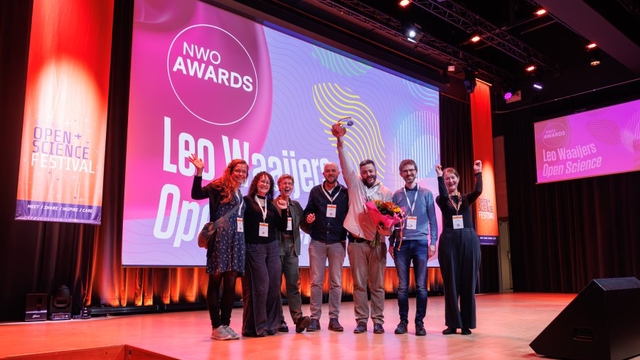
FORRT’s Director, Dr. Flávio Azevedo, received the prestigious NWO UKB Leo Waaijers Open Science Award 2026 celebrating the work done by FORRT (Framework for Open and Reproducible Research Training). This recognition for FORRT’s efforts and activities is wonderful recognition for the community-led effort that FORRT advocates for.
FORRT was well represented at this year’s Big Team Science Conference 2026 hosted by the CONNECT Working Group. Take a look at FORRT’s Zenodo Commuity to see our conference presentations and see some additional recent publications!
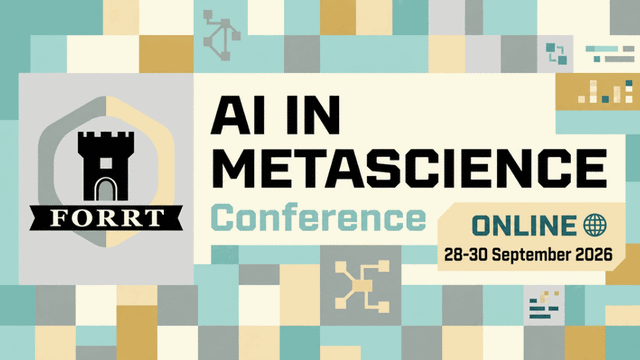
Thank you to everyone who took part in the FORRT AI in Metascience Online Conference (28–30 September 2026). Recordings of 32 talks are now on the FORRT YouTube channel, with one playlist per day: AI in the research pipeline, replications and reproductions, and analyst variability and workshops. The conference page has the full programme, with the abstract and recording of each talk.
Subscribe to our newsletter to get the latest news about FORRT's initiatives, events, and opportunities.
What is FORRT?
In a nutshell, FORRT is a Framework for Open and Reproducible Research Training advancing research transparency, reproducibility, rigor, and ethics through pedagogical reform and meta-scientific research. FORRT provides a pedagogical infrastructure & didactic resources designed to recognize and support the teaching and mentoring of open and reproducible science. FORRT strives to raise awareness of the pedagogical implications of open and reproducible science and its associated challenges (i.e., curricular reform, epistemological uncertainty, methods of education) and advocates for the opening and formal recognition of teaching and mentoring materials to facilitate access, discovery, and learning to those who otherwise would be educationally disenfranchised.
Expand to learn more
Presentation of FORRT projects
The problem
Recently, the scientific community took steps to reflect a widespread awareness of, and call for, improved practices ushering in the “credibility revolution” including higher standards of evidence, preregistration, direct replication, transparency, and openness.
Structurally, three pillars were proposed to carry social sciences towards academic utopia: opening scientific communication, restructuring incentives and practices, and collaborative and crowdsourced science.
However, ongoing attempts have neglected an essential aspect of the academic machinery: students. And indeed, current norms for the teaching and mentoring in higher-education are rooted in obsolete practices of bygone eras. Improving transparency and rigor of science is the responsibility of all who engage in it.
The solution
In our view, a scientific utopia has a fourth pillar, whose principal goal is to familiarize higher-ED students, who are future consumers of science and perhaps themselves knowledge producers, with the intricacies of the process of science.
We believe the teaching and mentoring of reproducible and open research practices is the clearest indicator of the degree to which institutions and/or departments embody principles of credible science.
This demonstration goes beyond paying lip service to best practices, and ensures that students are trained to engage in the best available scientific practices.
FORRT is designed by, and envisioned for, educators who wish to integrate typical discipline content with open and reproducible science tenets.
FORRT supports this endeavor through a three-pronged approach:
Provide educators a comprehensive but straightforward framework to teach and mentor open and reproducible science as well as qualify and quantify the degree of open and reproducible research practices in their teaching and mentoring.
Equipping educators with high quality pedagogical tools on open and reproducible science practices to facilitate its integration into curricula and educators’ teaching mentoring, and research practices.
Modifying the academic incentive structure regarding teaching and mentoring through recognition and commendations of excellent teaching and mentoring; foster social justice through the opening and democratization of scientific-educational resources to those who otherwise would be educationally disenfranchised; and building a community with existing educational initiatives and strengthening our missions, identify and reduce redundancies, and streamline the advancement of open educational practices.
FORRT has published meta-scientific works, and has ‘soon-to-be-published’ manuscripts advocating and explaining why open and reproducible tenets should be incorporated in the teaching and mentoring of prototypical subject matters. In line with principles enshrined in FORRT, all manuscripts and ongoing projects are open (online) contributorship projects. The work of all contributors are valued and are formally recognized hoping expand the scope and diversity of FORRT’s mission and its team.
FORRT creates, collects and catalogues examples of successful pedagogical approaches in teaching and mentoring as well as the openness of these resources. Interested parties – i.e., scholars, instructors, and educational institutions – can use FORRT’s pedagogies as a template towards the creation of their own teaching strategies. FORRT pedagogies strives to support teachers and mentors to integrate field-specific education with open and reproducible science tenets.
At any given time, FORRT has several ongoing, dynamic projects. These range from developing educational resources, to metascience research, to highlighting the perspectives of marginalized groups. Our philosophy is rooted in community science and open contributorship: anyone willing to help can contribute to FORRT projects, including you!
FORRT is one of the few initiatives worldwide to be formally endorsed as a Programme of the
International Decade of Sciences for Sustainable Development (IDSSD, 2024–2033) , led by UNESCO and the United Nations (UN). This endorsement reflects the highest level of UN policy recognition and positions FORRT’s work in Education & Pedagogy (Curriculum Hub), Metascience & Research (Replication Hub) and Social Justice & DEIA as an essential contribution to the UN’s strategy for achieving the Sustainable Development Goals (SDGs).
Better education is for everyone. Help us spread the word by sharing FORRT content via
Bluesky,
YouTube,
Facebook, your professional listservs, and other social media.
Join Our Teams
Everything we develop and produce is in the open and open to anyone willing to help. Check out our
several teams here and our
get-involved page too.
Become a Partner
We partner up with other meta-scientific and educational institutions and initiatives to help us to further develop and improve the principles enshrined in FORRT. If your organization or initiative is considering discussing becoming a partner,
email us.
The majority of FORRT’s operations go through our Slack channel. We use Slack to keep everyone up-to-date, coordinate teams, and provide a platform for ongoing discussions on our projects.
You can join us here.