
About us
Advocating for the integration of open and reproducible science into higher education
In a nutshell, FORRT is a Framework for Open and Reproducible Research Training which is advancing research transparency, reproducibility, rigor, and ethics through pedagogical reform and meta-scientific research.
FORRT provides a pedagogical infrastructure and open educational resources designed to support the teaching and mentoring of open and reproducible science. FORRT strives to (a) raise awareness of the pedagogical implications of open and reproducible science and its associated challenges (i.e., curricular reform, epistemological uncertainty, methods of education); (b) respond to calls to consider open scholarship as inclusive scholarship; (c) advocate for the opening and formal recognition of teaching and mentoring materials to facilitate access, discovery, and learning to those who otherwise would be educationally disenfranchised.
Here’s a 5-minute introduction to FORRT
Playing this video loads it from YouTube (Google). See our privacy policy.
What are FORRT’s goals?
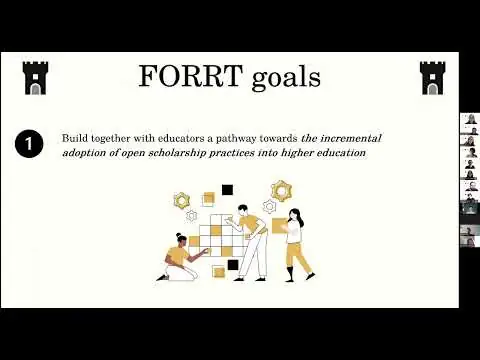
- Build, together with educators, a pathway towards the incremental adoption of open scholarship practices into higher education
- Generate a conversation about the ethics and social impact of a higher education pedagogy that emphasizes openness, epistemic uncertainty and research credibility
- Promote a reflection about the perceived importance of different academic activities and advocate for greater recognition of educational resources
Learn more about FORRT in the interactive flipbook:
Want to learn more about us?
Our community has published meta-scientific peer-reviewed papers & policies (and we also have ongoing manuscripts being written) so please consider reading our award-winning scholarship on the FORRT’s Publications page, or start with our manifesto on the OSF.
If you’re looking for open educational resources, please take a look at our Educational Nexus and our FORRT Pedagogies.
For more information about our goals and values, read our Mission Statement, Code of Conduct, and our quest towards Principled Teaching and Mentoring.
If you’re looking for information about who we are or our organizational structure, take a look at the teams that compose FORRT, the institutions and initiatives with which we are partners, and our community members.
Would you like to get involved more with FORRT? Check out our getting involved page!
Would you like to help us be or do better? Give us (anonymous) feedback in our feedback page.
Playing this video loads it from YouTube (Google). See our privacy policy.
😊
History
This project was initiated at the 2018 meeting of the Society for the Improvement of Psychological Science in the “Teaching replicable and reproducible science” hackathon led by Kristin Lane and Heather Urry. The initial framework was developed in a subsequent working group consisting of: Flávio Azevedo, Sam Parsons, Carl Michael Galang, Kristin Lane, Lisa DeBruine, Benjamin Le, Donald Tellinghuisen, and Madeline Harms (we apologise if we have missed anybody - please let us know). If you are interested in learning about how FORRT developed and matured, our first website is still online. Fun fact, FORRT was ‘born’ in Grand Rapids, Michigan, on Sunday, June 24th, 2018, at approximately 4pm local time.
Build your own FORRT tower
Building with toy bricks can be a useful metaphor for young and old to convey how research should be shared openly and for free, required materials should be shared (parts list), and the method should be described in detail for others to reproduce (instruction manual). So what could be more fitting than sharing instructions for a LEGO FORRT? You can download the full parts list and instructions for free via Rebrickable.