
Overview
Citations can be thought of as a currency in the academy, where more citations equals more prestige. While the system assumes a meritocracy—where higher citation counts supposedly indicate higher quality because a work is deemed valuable and legitimate by peers—this perspective ignores inherent biases and systemic inequalities. In reality, citation practices often function as mechanisms of exclusion, gatekeeping, and reproduction of existing power structures, reinforcing the dominance of certain groups over others. These issues span from individual choices in citation to structural issues with search engines; here we introduce a toolkit that individuals can use to encourage a conscientious, and more just, citation practice.
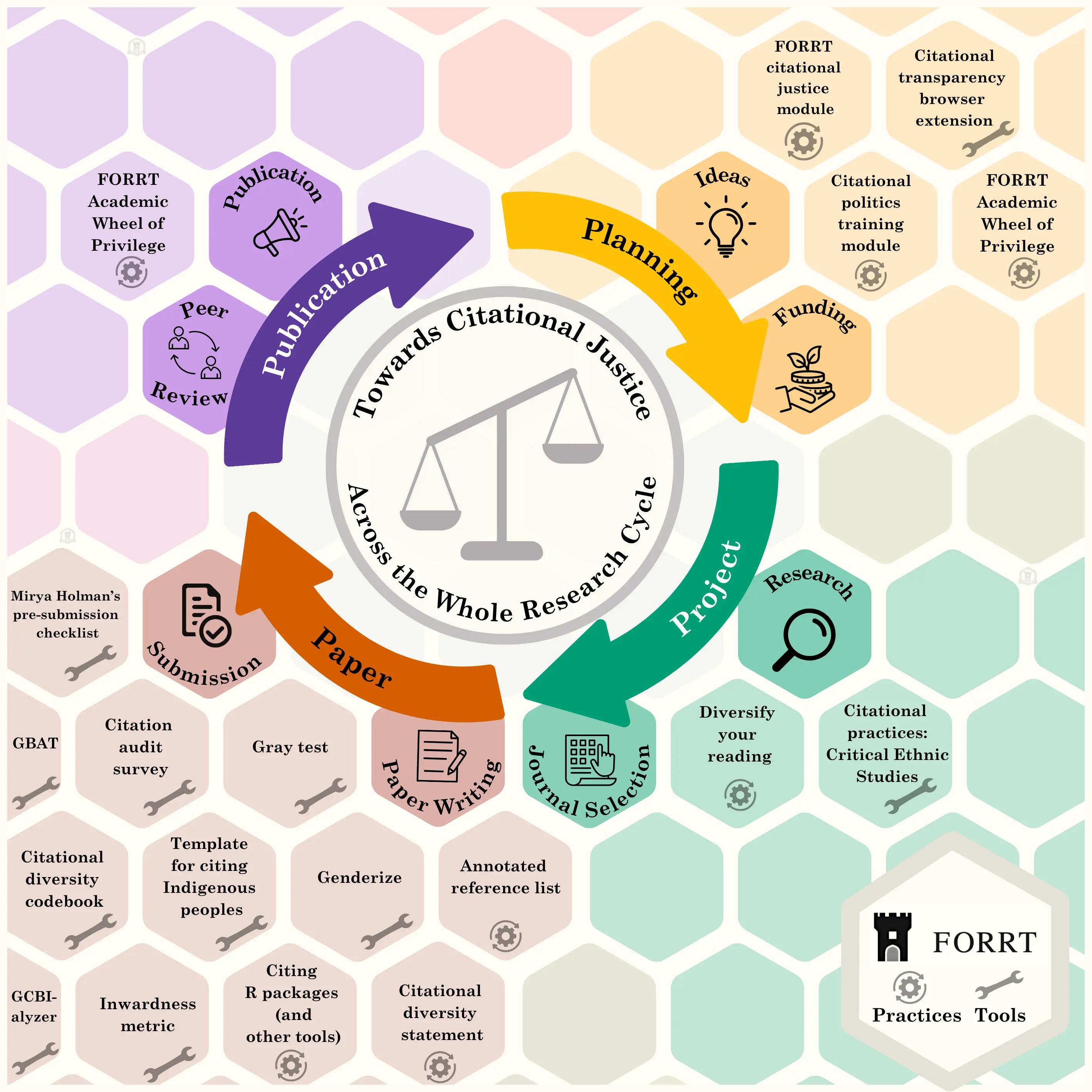
The Citational Justice Toolkit organizes a collection of tools and practices by their application to four stages of the research cycle: planning, project, paper and publication. Researchers are encouraged to apply any tool or practice, or as many as they wish, at any point in the research cycle. Many of these tools and practices can become integrated into regular research workflow, ultimately leading to more just citational practices as a matter of course.
The aim of this toolkit is to encourage individual researchers to become conscientious in their citation practices, using their citation choices to distribute power more equitably in the academy. We invite you to explore the Citational Justice Toolkit and join us in promoting equity and justice in academia.
Cite as:
Sauvé, S. A., Middleton, S. L., Gellersen, H., & Azevedo, F. (2025, July 31). In Pursuit of Citational Justice: A Toolkit for Equitable Scholarship. https://doi.org/10.31222/osf.io/qjecy_v2
Toolkit
We provide a suite of resources to support the use and implementation of the Citational Justice Toolkit:
Toolkit WebsiteManuscript
Decades of empirical research across disciplines reveal the pervasiveness of citation biases along axes of gender, race, geography, and epistemology. Who we cite reflects and reinforces both the boundaries and hierarchies of academic knowledge, covertly shaping not only whose research is legitimized and valued but also whose careers are advanced. Citations, the currency of the academy with power to reinforce or dismantle hierarchies that privilege dominant knowledge systems cannot thus be a neutral, apolitical act. This paper unpacks the concept of citation politics and its role in sustaining epistemic hierarchies within scholarly communities. Rather than framing citation bias as a matter of individual oversight, we position it as a systemic issue tied to academic structures, norms, and incentive systems. We introduce a comprehensive and openly accessible Citational Justice Toolkit, developed by the FORRT community, which curates actionable resources, tools, and practices helping scholars and institutions to audit, diversify, and reflect on their citation practices across the research cycle. Our aim is to support a shift from tokenistic inclusion toward epistemically accountable, socially responsible, and structurally aware scholarship. We argue that reimagining citation as an ethical and epistemic practice is foundational to building a just and inclusive academic ecosystem, fostering pluralism, transparency, and integrity in knowledge production.
Video guide
You’ve read our manuscript and now you’re wondering how to get started? This video will walk you through the first steps you can take on your journey towards citational justice, featuring several tools and practices from our toolkit.
Playing this video loads it from YouTube (Google). See our privacy policy.
Coming Up
Citation Self-Audit
This guide will walk you through using the Citational Justice Toolkit to conduct an audit on your own work and more importantly - how to pinpoint tools and practices to help you make targeted changes. In development in English and Spanish.
FORRT citational justice module
This material will help you spread the word about citational justice in your own teaching.
Diversify Your Content Workshop
This workshop will guide you through applying the Citational Justice Toolkit to teaching content using focused questions to target changes. In development in English and Spanish.
Get involved!
This toolkit and accompanying manuscript are only the first piece of work produced by FORRT’s Team Citation Politics. For FORRT’s Team Citation Politics (#citation-politics), we devised a few action points we will be working on:
Toolkit Expansion and Infrastructure Building
- Modularize the toolkit by audience: for authors, editors, instructors, students.
- Create an interactive online dashboard to visualize citation audits
- Add discipline-specific add-ons (e.g., citational politics in psychology vs. physics vs. education).
- Translate into multiple languages (for inclusivity and global engagement).
Empirical Research Agenda
- Launch a study or dashboard documenting uptake of the toolkit.
- Conduct longitudinal citation audits by field or journal using gender, region, epistemology as categories.
- Develop or refine methods for ethical demographic inference using community consultation and validation.
- Benchmark (per field and per category) citational diversity.
- Integrate and expand categories with those of the Academic Wheel of Privilege.
- Study via Dimensions & Altmetric data to see whether citations across papers with low and high diversity rank higher or lower on Dimensions & Altmetric areas.
Pedagogical Integration
- Develop lesson plans or mini-courses on citational justice for undergrad and graduate levels.
- Offer “Citation Justice Audits” as a classroom or lab-based activity.
- Build partnerships with educational institutions, writing centers, and PhD programs to mainstream ethical citation training.
Institutional Policy Engagement
- Collaborate with academic publishers, funding agencies, and research offices to:
- Add citational ethics criteria in journal editorial guidelines.
- Include citation audits in grant application protocols or DEIA reviews.
- Propose policy changes within hiring, tenure, and promotion frameworks.
Coalition-Building
- Form a FORRT-led network of citation justice advocates.
- Organize a citational justice conference or symposium with panels on data ethics, metrics reform, and DEI in publishing.
- Partner with initiatives like DORA, CRediT, AfricArXiv, or PREreview to co-develop standards.
Critical Discourse Amplification
- Publish a shorter companion piece for Nature Human Behaviour or The Conversation to distill key points.
- Use social media and public writing to popularize the metaphor of citation as epistemic infrastructure.
- Share testimonies of those excluded from citations (e.g., oral histories, blog interviews).
If you see yourself in any of these plans or have any other ideas or suggestions for development of the toolkit, or other ways of engaging with citational practice or patterns (especially as it relates to open research), get in touch via the #citation-politics channel on FORRT’s Slack, email the team at citation-politics@forrt.org, or DM either Team Co-Lead Sarah Sauvé or Helena Gellersen on FORRT’s Slack.
Cite as:
Sauvé, S. A., Middleton, S. L., Gellersen, H., & Azevedo, F. (2025, July 31). In Pursuit of Citational Justice: A Toolkit for Equitable Scholarship. https://doi.org/10.31222/osf.io/qjecy_v2