
Citation Politics Toolkit
A toolkit to encourage thoughtful citation: tools and practices for citational justice at each stage of the research cycle, from planning a project to publishing it. Each entry is marked as a tool or a practice, and the wheel shows where it fits.
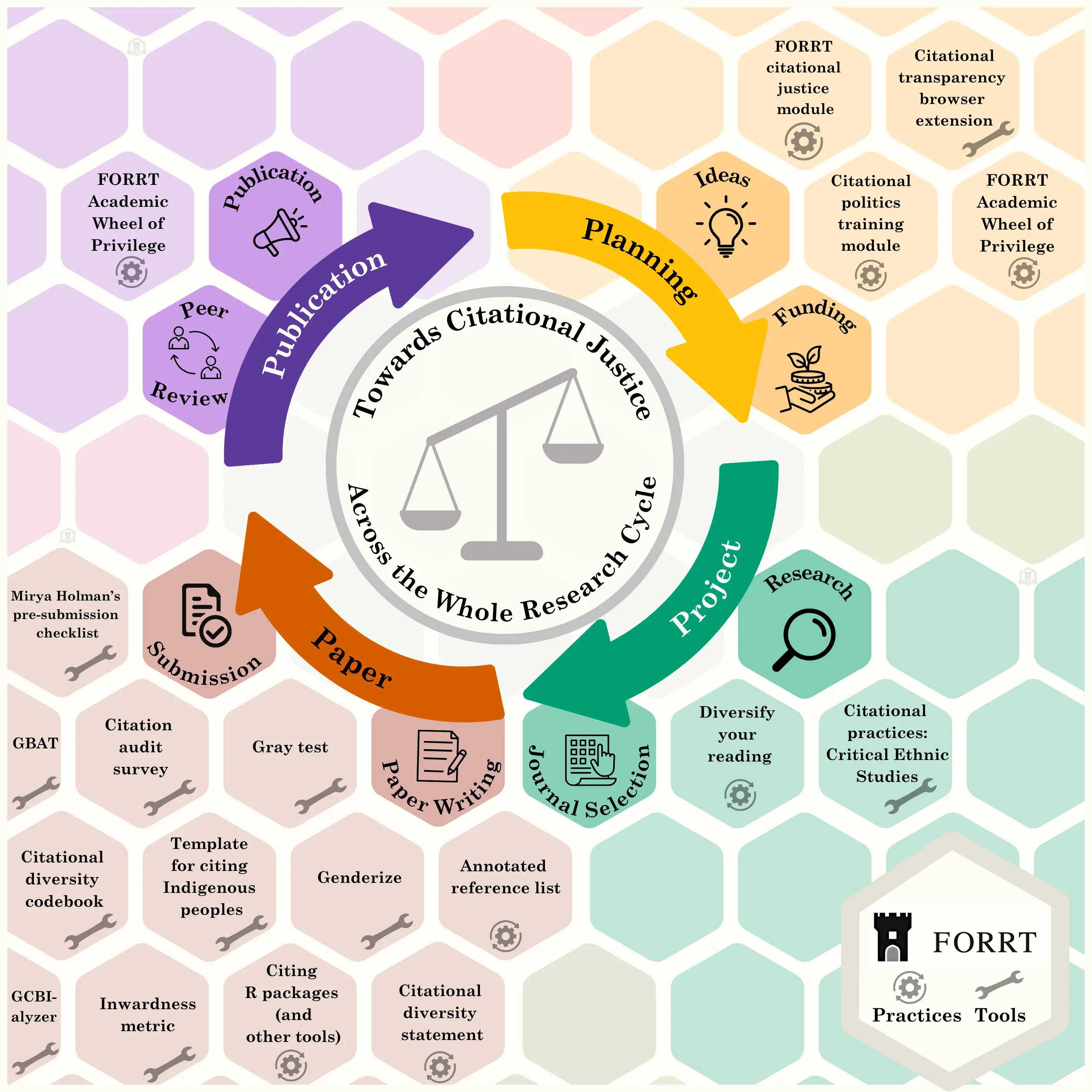 Open the wheel full size
Planning
On the wheel: Ideas and funding
- Tool Citation Transparency browser extension
- Tool FORRT citational justice module Coming soon
- Tool Citational politics training module CLEAR, Civic Laboratory for Environmental Action Research
- Practice Academic Wheel of Privilege (AWoP)
Project
On the wheel: Research and journal selection
- Tool Citational Practices: Critical Ethnic Studies
- Practice Diversity reading See the diversity reading tools below
Paper
On the wheel: Paper writing and submission
- Tool Mirya Holman's pre-submission checklist
- Tool Gender Balance Assessment Tool (GBAT)
- Tool Citation audit survey Darda et al., 2023
- Tool Gray test Belcher, 2019
- Tool SIBL Citation Audit Template
- Tool Citational diversity codebook
- Tool Genderize
- Tool Template for citing Indigenous peoples MacLeod, 2021
- Tool GCBI-alyzer
- Tool Inwardness metric Baccini et al., 2019
- Practice Annotated reference list Lawson et al., 2025
- Practice Citational diversity statement Zurn et al., 2020
- Practice Citing R packages (and other tools)
Publication
On the wheel: Peer review and publication
- Practice Academic Wheel of Privilege (AWoP) Also listed under Planning
Diversity reading tools
Databases, networks and guides that help you find and read work by scholars from under-represented groups.
- Diverse speakers in STEM Database of databases of diverse speakers in STEM (includes some of the tools in this list, and much more)
- CiteBetter A community-driven pledge to promote equitable and inclusive citation practices, especially for scholars of color and non-cis-male voices. Offers minimum standards across roles (students, teachers, researchers, department chairs) to actively address citation bias. From “Our Pledge” and “Statement of Purpose” on citebetter.com
- Citation justice in STEMM McGill library list of tools and resources to help diversity reading and perform citation audits
- Citation Practice Self-Audits Faculty-led assessments of syllabi and reading lists to identify underrepresentation of women and scholars of color; encourages more inclusive citation practices across teaching and publishing. Promotes critical reflection and gradual change. From Promising Practices for Addressing the Underrepresentation of Women in Science, Engineering, and Medicine
- Equity-Informed Editorial and Review Guidelines Proposes journals adopt guidelines that encourage authors, editors, and reviewers to consider gender and racial balance in citations. Promotes institutional accountability in publishing. From Promising Practices for Addressing the Underrepresentation of Women in Science, Engineering, and Medicine
- Diverse Sources Database of experts to include more underrepresented voices and perspectives in science, health and environment work
- Women in Neuroscience Women in neuroscience
- 500 Women Scientists Women scientists across disciplines
- Anne's List Women systems neuroscientists
- Women in Coastal Geoscience and Engineering Aims to inspire, support, and encourage women at all career stages through networking and mentoring
- Women in Earth and Environmental Sciences in Australasia Creating a unified Australasian network of women working in Earth and Environmental Sciences in academia, industry and government
- Global South Climate Database The Global South Climate Database is a publicly available, searchable database of scientists and experts in the fields of climate science, policy and energy.
- BIPOC-authored psychology papers A moderated database of papers to help course instructors diversify their syllabi.
- Black in Neuro Black neuroscientists
- Cite Black authors Black authors across disciplines
- BlackComputerHer Black women and girls in computing and tech Links to the citeHER Bibliography
- Cite Black Women Collective A movement that engages with social media and aesthetic representation (t-shirts) in order to push people to critically rethink the politics of knowledge production by engaging in a radical praxis of citation that acknowledges and honors Black women’s transnational intellectual production.
- Canadian Black Scientists Network The Canadian Black Scientists Network (CBSN) exists to Elevate, make Visible, Celebrate and Connect Black Canadians in Science, Technology, Engineering, Mathematics & Medicine (STEMM) across sectors.
- BiasWatchNeuro A website that tracks the women:men ratio of invited speakers at neuroscience conferences, workshops, and courses, as well as authors in neuroscience journals and recipients of neuroscience awards.
- 500 Queer Scientists Queer scientists
- The Bee Literary magazine, online platform, podcast, and the heart of a writing community. Our mission is to nurture, publish and promote the best new working-class writing by new and established working-class writers and visual artists. New Writing North
- marginalia Marginalia are committed to […] promoting female, non-gender conforming, POC, LGBTQIA+, differently abled or in any other way not promoted by the status quo in academia.
- Reviewer Zero Reviewer Zero aims to transform peer review in psychology and related fields to be more formative and constructive, reducing bias and promoting equity, especially for underserved groups. They provide training for reviewers, develop supportive review practices, and promote diverse research perspectives.
- JANE (Journal/Author Name Estimator) Find papers, journals or authors based on your manuscript title, abstract or keywords. Can be used to find peer reviewers or additional literature to cite.
- Diversity Reading List in Philosophy Diversity in philosophy
- Advancing big-team reproducible science through increased representation (ABRIR) ABRIR is a working group that aims to diagnose the unique barriers to leadership & participation in Big-team/Open Science faced by researchers from LMICs (low-to-middle income countries).
- Framework for Open and Reproducible Research Training (FORRT) - Neurodiversity Supporting the messages of both open scholarship and neurodiversity will ensure that the goals of diversity, equity, and inclusion reach across populations and explicitly include neurodivergent people. Includes a database of neurodivergent authors Submit to the database of neurodivergent authors
- Indigenous Science Network A network promoting First Nation/Indigenous science. Regular newsletters and resources for educators.
- City University of Seattle guide to Finding Indigenous Voices Tips for how to search for Indigenous voices in research
- Advancing Indigenous People in STEM (AISES) AISES is a national nonprofit organization focused on substantially increasing the representation of Indigenous peoples of North America and the Pacific Islands in science, technology, engineering, and math (STEM) studies and careers.
- Anti-colonial research library (ACRL) This Library holds a collection of open-access articles and books, websites, and YouTube videos on Indigenous and anti-colonial research methodologies.
Cite as
Sauvé, S. A., Middleton, S. L., Gellersen, H., & Azevedo, F. (2025, July 31). In Pursuit of Citational Justice: A Toolkit for Equitable Scholarship. https://doi.org/10.31222/osf.io/qjecy_v2