|
November 2024
Welcome to FORRT's newsletter!
With this newsletter, we hope to inform the larger community about FORRT's activities in the last months, and plans in the upcoming months. This digest is intended to help you cut through the noise and stay involved. If you missed our last newsletter, you can find it here.
We'd love to hear your feedback, email info@forrt.org if you have thoughts or questions.
|
|

Project Updates
Do you have 15 Minutes to spare?
Contribute to our project and be acknowledged as a contributor in an E-Book!
FORRT is working on a transdisciplinary project, aiming to gather insights from diverse disciplines and regions to map and critically evaluate feedback strategies across the research cycle. We hope that this will be particularly beneficial for marginalised and early-career researchers. One of the key outputs will be an e-book, and we need your help to ensure our survey translations are clear and accurate.
To make the survey as accessible as possible, we’ve enabled various translations. If you're fluent in a language other than English, we’re asking for approximately 15 minutes of your time to review the automated translation of the survey generated through Qualtrics and highlight any issues or unclear areas. In exchange for your support, we'll acknowledge your contribution in the e-book.
If you're interested, please get in touch with Roksana Sobolak (email: r.a.sobolak@greenwich.ac.uk) to learn more. Your help will make a big impact on the success of this project! Read more about the project here.
Collaboration between COS and FORRT
The Center for Open Science has partnered with FORRT and its resource, the FORRT Replication Database (FReD). The aim of the collaboration is to enhance FReD to serve as a vital resource of replication outcomes, and establish the database as a more robust tool for the broader research community. Read more about the collaboration here.
Read below to find out about a paid opportunity to support the initiative to enhance FReD!
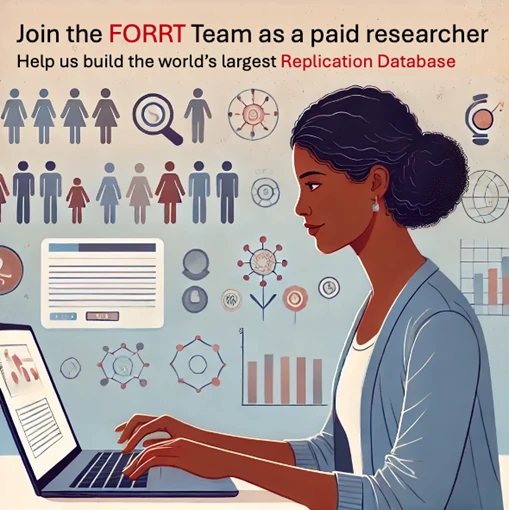
Paid opportunity: Join FORRT's Replication Database as a Data Curator!
We’re on a mission to build the world’s largest database of replication studies, to make replications more visible and support meta-science. With support from the Center for Open Science, FORRT is looking for a team of paid Data Curators to help grow and validate this essential resource. The work is flexible over the next 6 months — starting as soon as possible and all done remotely! It is a great opportunity for students who want to gain research experience - or anyone else who wants to contribute to this mission. So please share within your network.
The Role of a Data Curator
Enter and validate entries for our replication database. Conduct systematic searches to add new studies, expanding our collection. Document your work for transparency and high data quality.
Why Join Us?
Make a direct impact on research transparency and replication efforts. Work flexibly from anywhere, developing skills in coding, data validation, and systematic review. Be part of a dedicated community advancing Open Science!
Interested?
Check out the full job description and fill in the application form to apply!
|
|

Events and Meetings
Do you want to be listed as a contributor to an e-book and associated summary paper/ pre-print?
We're excited to announce the launch meeting for our transdisciplinary project exploring accessible feedback mechanisms across all stages of the research cycle. This initiative, driven by the principles of open scholarship, aims to create an e-book that maps and critically evaluates existing feedback strategies.
Meeting date: Thursday, 12th December
Time: 12:00pm midday UK time
Click here for the link to join the event.
Why Get Involved?
Contributors will have the opportunity to:
- Gain recognition through a contributorship list.
- Play a vital role in a project aimed at helping marginalised and early career researchers improve their research quality.
- Be part of an initiative fostering cross-disciplinary sharing of ideas and practices.
Our Goal
To ensure that everyone has an equal opportunity to thrive in academia, tackling issues like privileged gatekeeping, delayed feedback, and exclusion.
What to Expect at the Meeting
We’ll provide a brief overview of the study’s goals and outline ways FORRT members can contribute, including:
- Survey participation
- Translating survey materials
- Helping with regional recruitment
- Supporting qualitative and quantitative analyses
Join us in synthesising insights and data from around 1,000 academic staff worldwide to build a resource that reshapes feedback culture in academia. Let’s work together to create a more inclusive and richer future for researchers everywhere. Read more about the project here.
If you have any further queries, please email Roksana Sobolak, r.a.sobolak@greenwich.ac.uk.
We look forward to seeing you there!
|
|
|
Social Media
As a reminder, you can follow FORRT on multiple social media platforms to find out our latest news. Our new main channel we will be posting through is Bluesky, follow us here.
You can also find the latest FORRT news on:
|
|

Get Involved
Regular meetings - everyone welcome
- Many FORRT project teams meet regularly, and anyone is welcome to join. Check out all these events and more in our online FORRT Calendar!
Code of conduct
- We have a code of conduct to reflect an open, welcoming, diverse, and inclusive community mission. We ask everyone at FORRT to read our CoC and abide by it in all FORRT-related interactions and spaces.
|
|

In case you missed it
In this section, we'll highlight several different past achievements from FORRT to showcase again the amazing work accomplished:
- Pownall, M., Azevedo, F., König, L. M., Slack, H. R., Evans, T. R., Flack, Z., ... & FORRT (2023). Teaching open and reproducible scholarship: a critical review of the evidence base for current pedagogical methods and their outcomes. Royal Society Open Science, 10(5), Article 221255.
- Korbmacher, M., Azevedo, F., Pennington, C. R., Hartmann, H., Pownall, M., Schmidt, K., ... & Evans, T. (2023). The replication crisis has led to positive structural, procedural, and community changes. Communications Psychology, 1, 3.
- Gourdon-Kanhukamwe, A., Kalandadze, T., Yeung, S., Azevedo, F., Iley, B. J., Phan, J. M., ... & Elsherif, M. M. (2023). Opening up understanding of neurodiversity: A call for applying participatory and open scholarship practices. The Cognitive Psychology Bulletin, 8, 23-27.
- Parsons, S., Azevedo, F., Elsherif, M. M., Guay, S., Shahim, O. N., Govaart, ... & Aczel, B. (2022). A Community-Sourced Glossary of Open Scholarship Terms. Nature Human Behaviour, 6(3), 312-318. Please see here for the open access version.
|
|
|
|