|
January 2025
Welcome to FORRT's newsletter!
With this newsletter, we hope to inform the larger community about FORRT's activities in the last months, and plans in the upcoming months. This digest is intended to help you cut through the noise and stay involved. If you missed our last newsletter, you can find it here.
We'd love to hear your feedback, email info@forrt.org if you have thoughts or questions.
|
|

Project Updates
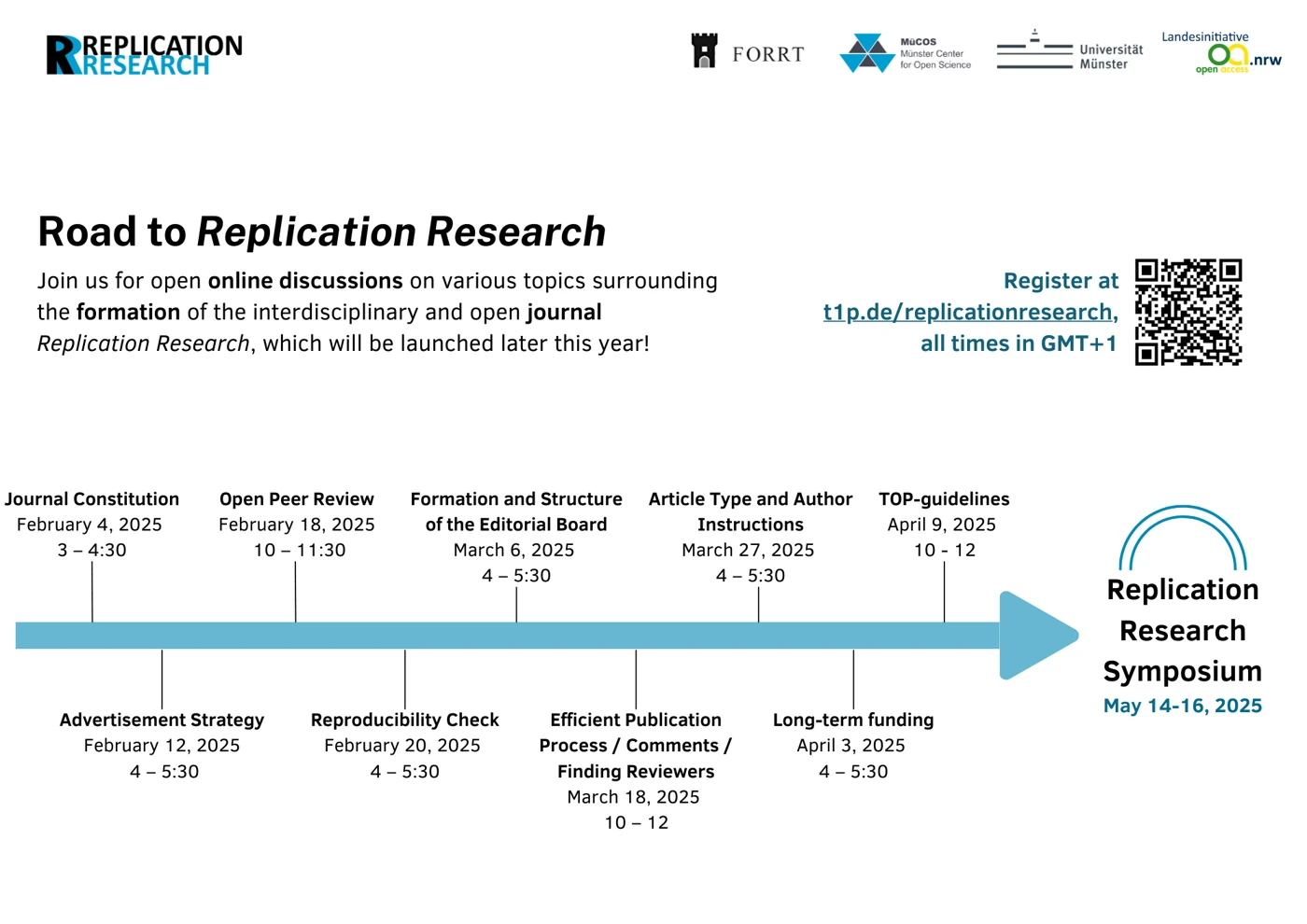
Gain unique insights into the formation of a FORRT community-driven diamond open access journal!
Traditional journals have been resistant to publishing replication research, which prevents replications from becoming mainstream. FORRT and the Münster Center for Open Science are launching a researcher-led diamond open access journal in late 2025.
From February until May, we will be discussing core features, editorial procedures, and the scope of the journal in a series of online discussions. The entire process is open and we invite you to join us on the Road to Replication Research.
Participants (including explicitly early-career scholars, minoritized and underrepresented individuals) will have the unique opportunity to witness discussions that are usually held behind closed doors with commercial interests at the top. We at FORRT and the MCOS want to provide a stark contrast to this so that our journal's innovative features such as the preprint first policy, open peer review, reproducibility checks, and strict TOP guidelines are comprehensible! Join us and register to participate here.
New FORRT initiative - Open Social Psychology textbook
Call for contributors
We have a new community initiative at FORRT to develop an open-access textbook on social psychology. Our goal is to summarize classical findings and discuss them in light of replication attempts. Current textbooks rarely address changes to perceptions of landmark studies, and we aim to provide an accessible, open science resource that does.
There are currently 16 draft chapters of this textbook written by undergraduate students (credited as first authors). Improving and finishing these chapters is the project’s current number one priority.
To do so, we are looking for researchers (experienced PhD students or people who have already obtained their PhD) whose work touches on social psychology and related areas of experimental research to contribute. Revising a chapter comes with an estimated 5-10 hours of work (across 2-3 months) and credit as a chapter co-author. You can find more information on the project here, and if you have any questions you can contact Rima-Maria Rahal via rahal.rimamaria@gmail.com.
Please make sure to read the project’s guidelines here before making a contribution. Join our Hackathon to learn more about the project and find a chapter to work on:
📅 February 14, 2025, 2:00 pm UTC on Zoom.
Join our mission to transform academic feedback:
Multiple ways to get involved!
FORRT is working on a transdisciplinary project aimed at gathering insights from diverse disciplines and regions to map and critically evaluate feedback strategies across the research cycle. We hope that this will be particularly beneficial for marginalised and early-career researchers.
Data collection ends in March, so we encourage academic researchers to participate in the study and share their insights and experiences of feedback throughout their research projects. You can access the survey here.
If you’re interested in getting more involved, there are other ways to contribute to the project. Your contributions will be acknowledged in our main outputs, including an e-book and journal publications. At this stage, we’re particularly in need of help with participant recruitment, though there are other collaboration opportunities available as well.
For more details or to express your interest, please contact Roksana Sobolak at r.a.sobolak@greenwich.ac.uk. Your support will make a significant impact on the success of this project!
New funding acquired for Replication Research
Team Replication at FORRT have acquired funding from the University of Münster as a Topical Program and by the state initiative 'openaccess.nrw'. These funds will support the delivery of a Replication Research Symposium (14-16 May 2025), and development of an Open Access journal, Replication Research.
The Topical Program proposal is available online. The openaccess.nrw proposal is available online.
|
|

Events and Meetings
Save the date: Replication Research Symposium 2025
When: 14th to 16th May 2025
Where: Münster, Germany
FORRT and the Münster Center for Open Science are hosting an international symposium on replication research. Across three days, participants and experts from different areas will discuss how replication and reproduction studies can be conducted and published in the social, cognitive, and behavioral sciences. The symposium will shape and define the scope of the interdisciplinary journal Replication Research, which will launch in late 2025.
|
|

Get Involved
Regular meetings - everyone welcome
- Many FORRT project teams meet regularly, and anyone is welcome to join. Check out all these events and more in our online FORRT Calendar!
Code of conduct
- We have a code of conduct to reflect an open, welcoming, diverse, and inclusive community mission. We ask everyone at FORRT to read our CoC and abide by it in all FORRT-related interactions and spaces.
|
|

In case you missed it
New paper from Team Neurodiversity:
- Zaneva, M., Coll-Martín, T., Héjja-Brichard, Y., Kalandadze, T., Kis, A., Koperska, A., ... & Zisk, A. H. (2024). An annotated introductory reading list for neurodiversity. eLife, 13, e102467.
Selection of previous FORRT publications you might have missed:
- Pownall, M., Azevedo, F., König, L. M., Slack, H. R., Evans, T. R., Flack, Z., ... & FORRT (2023). Teaching open and reproducible scholarship: a critical review of the evidence base for current pedagogical methods and their outcomes. Royal Society Open Science, 10(5), Article 221255.
- Korbmacher, M., Azevedo, F., Pennington, C. R., Hartmann, H., Pownall, M., Schmidt, K., ... & Evans, T. (2023). The replication crisis has led to positive structural, procedural, and community changes. Communications Psychology, 1, 3.
- Gourdon-Kanhukamwe, A., Kalandadze, T., Yeung, S., Azevedo, F., Iley, B. J., Phan, J. M., ... & Elsherif, M. M. (2023). Opening up understanding of neurodiversity: A call for applying participatory and open scholarship practices. The Cognitive Psychology Bulletin, 8, 23-27.
|
|
|
|