|
April 2025
Welcome to FORRT's newsletter!
With this newsletter, we hope to inform the larger community about FORRT's activities in the last months, and plans in the upcoming months. This digest is intended to help you cut through the noise and stay involved. If you missed our last newsletter, you can find it here.
We'd love to hear your feedback, email info@forrt.org if you have thoughts or questions.
|
|

Newsletter Highlights
Get Paid to Co-Create Open-Access Educational Materials!
FORRT is launching a funded initiative to co-create open-access, inclusive teaching materials to make open science more inclusive and accessible beyond elite institutions and Global North/ WEIRD contexts.
Contribute a set of materials and earn €400. Each set should include:
-
A set of teaching slides with script and pedagogical notes, editable and aligned with FORRT's Clusters.
-
A set of structured lesson plans incorporating student activities, styled according to Pownall et al. (2024).
-
All materials are designed to follow Bloom’s Taxonomy and are openly shared under a CC BY-NC-SA 4.0 license.
Contributors will be credited on FORRT’s Contributors page and directly on the materials, and may be invited to co-author resulting publications (provided authorship criteria are met). Want to find out more? Please read here for additional information for contributors.
Join us in democratizing open science education!
📩 Interested? Email: team-curriculum@forrt.org
|
|

Project Updates
New from FORRT: Revolutionizing Educational Research!
Introducing ELD CAMA — the Evidence in Learning and Didactics Community-Augmented Meta-analysis platform that transforms how we synthesize and share educational research. Unlike traditional reviews, ELD CAMA lets users upload individual studies, enabling real-time, open, and collaborative evidence synthesis.
Join a living, growing ecosystem of open educational science. Explore the resource here.
Call for Research Assistants: Make Replications Count
We are looking for multiple research assistants (6–10h/week, 12 months) for a paid position starting June 2025 - offering flexible working times and location. Must be enrolled at a German university due to grant requirements (but can be from any nationality and background)!
- Code software tools to alert researchers about relevant replication studies.
- Coordinate multiple international projects such as coding hackathons.
- Organize and accompany qualitative interviews.
Check the full advert here.
📩 Questions & Applications:
lukas.roeseler@uni-muenster.de | l.wallrich@bbk.ac.uk
|
|

Events and Meetings
Join the FORRT Hackathon: Accessible Feedback in Academia E-Book!
Collaborate in real-time to write practical, inclusive chapters on feedback strategies across the research cycle by using existing descriptive analyses to guide you. No prep needed— relevant summaries and data provided. All contributors will be credited in the final community-maintained e-book.
📅 Thursday, 29 May | 11:00–13:00 BST | 12:00–14:00 CEST | 10:00–12:00 UTC
Join the session | Questions? r.a.sobolak@greenwich.ac.uk
Let’s co-create a better feedback culture in academia!
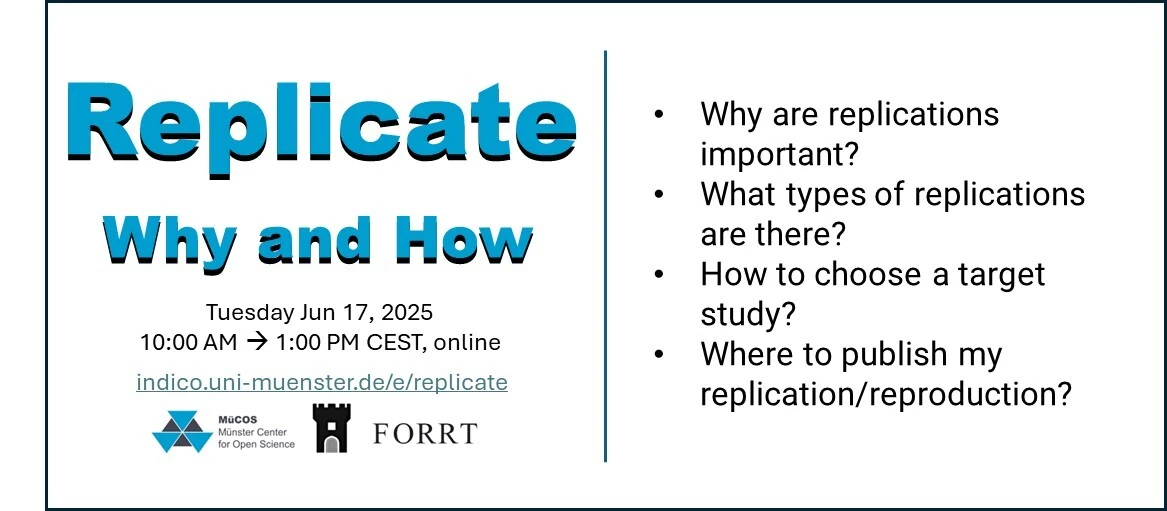
Apply for Participation in the Replication Workshop by FORRT and MüCOS
Doing research means building on something - but what if what you are trying to build on is brittle? Wouldn't you want to find out about that?
Apply for our 3 hour free online workshop.
Get you up-to-date on best practices of replications and reproductions!
📅 Tuesday, 17 June | 10:00–13:00 CEST | 09:00–12:00 BST | 08:00–11:00 UTC
|
|

Get Involved
Become a FORRT Intern!
Join a global community where learning meets impact. Turn your passion for education and social change into real contributions to open scholarship.
Ready to make a difference? Let’s go!
Read below what our interns have to say:
- Hello! I’m Panos Vasilikos from Greece, currently pursuing a Master’s in Social Changes, Policies and Interventions at Utrecht University. My background in Politics, Philosophy, Economics, and Psychology gives me a broad perspective on what drives social change, both individually and systemically. I believe education is key—and when it’s fun and engaging, it becomes even more effective. That’s why I’m particularly interested in how games can be used to raise awareness about Open Science. I’m excited to contribute to FORRT’s mission and learn from this inspiring community!
- Hi! I’m Antonia Krasteva, originally from Bulgaria and currently pursuing a Master’s in Youth Development and Social Change at Utrecht University. I joined FORRT as part of my program’s internship requirement, focused on positive youth development. Over time, though, it’s become much more than that—a meaningful opportunity to contribute to open scholarship and inclusive pedagogies through shared, transparent efforts. I see myself in FORRT’s mission, and because of that I’m excited to stay involved even beyond my internship.
Are you new and want to get involved with FORRT's projects?
Regular meetings - everyone welcome
- Many FORRT project teams meet regularly, and anyone is welcome to join. Check out all these events and more in our online FORRT Calendar!
Code of conduct
- We have a code of conduct to reflect an open, welcoming, diverse, and inclusive community mission. We ask everyone at FORRT to read our CoC and abide by it in all FORRT-related interactions and spaces.
|
|

In case you missed it
Selection of previous FORRT publications you might have missed:
- Azevedo, F., Parsons, S., Micheli, L., Strand, J., Rinke, E., … & FORRT. (2019). Introducing a Framework for Open and Reproducible Research Training (FORRT).
- Röseler, L., Kaiser, L., Doetsch, C. A., Klett, N., Seida, C., Schütz, A., … Zhang, Y., Mr. (2024). The Replication Database: Documenting the Replicability of Psychological Science.
- Pownall, M., Ghai, S., Fassi, L., Hayes, G., Schaaf, M., Chin, C., … Orben, A. (2024). What does Open Science mean for Educational Technology Research? Challenges, Opportunities, and a Call for Research.
|
|
|
|