13 Altruistic Punishment
written by Antonia Proßnigg (original draft). Stefanie Meyer (revision), Sonja Walcher (revision), and Hilmar Brohmer (revision)
13.1 The Classic
Imagine that the final assignment in one of your seminars is a group project with three other students. While you and two group members invest a high amount of effort to achieve a good result, the fourth member of your group contributes little to no work. Nevertheless, all four of you receive the same grade despite the differences in the amount of work towards the project. You request a private conversation with the professor to report the lack of contribution and suggest that the student should be held accountable. By doing so, you invest your own time and potentially risk social tension with your peers, while receiving no direct personal benefit. This scenario could count as an example of altruistic punishment.
#definition Altruistic Punishment
Altruistic punishment refers to the act of punishing individuals who benefit from cooperation of others without contributing to the public good. Importantly, the punishment imposes cost on the punisher, such as time, money or effort, while providing no immediate benefit for themselves (Fehr & Gächter, 2002).
#yourturn
Can you think of other situations where people might punish other people despite the associated personal cost and the absence of immediate benefits? Which factors might influence whether individuals choose to punish someone or refrain from doing so?
To examine whether individuals engage in altruistic punishment, Fehr & Gächter (2002) conducted a laboratory experiment using a public goods game. A public goods game, which is usually played on a computer, is used to study cooperation by asking people to make investments for a public good.
#definition Public Good
A public good can be defined as a goods subject that is consumed or used jointly and simultaneously by several people. However, joint coordination and investments by the people who use this public good may be required in order to maintain the usability of the public good. Additionally, the exclusion of someone from consuming this good is difficult or costly (V. Ostrom & Ostrom, 1979).
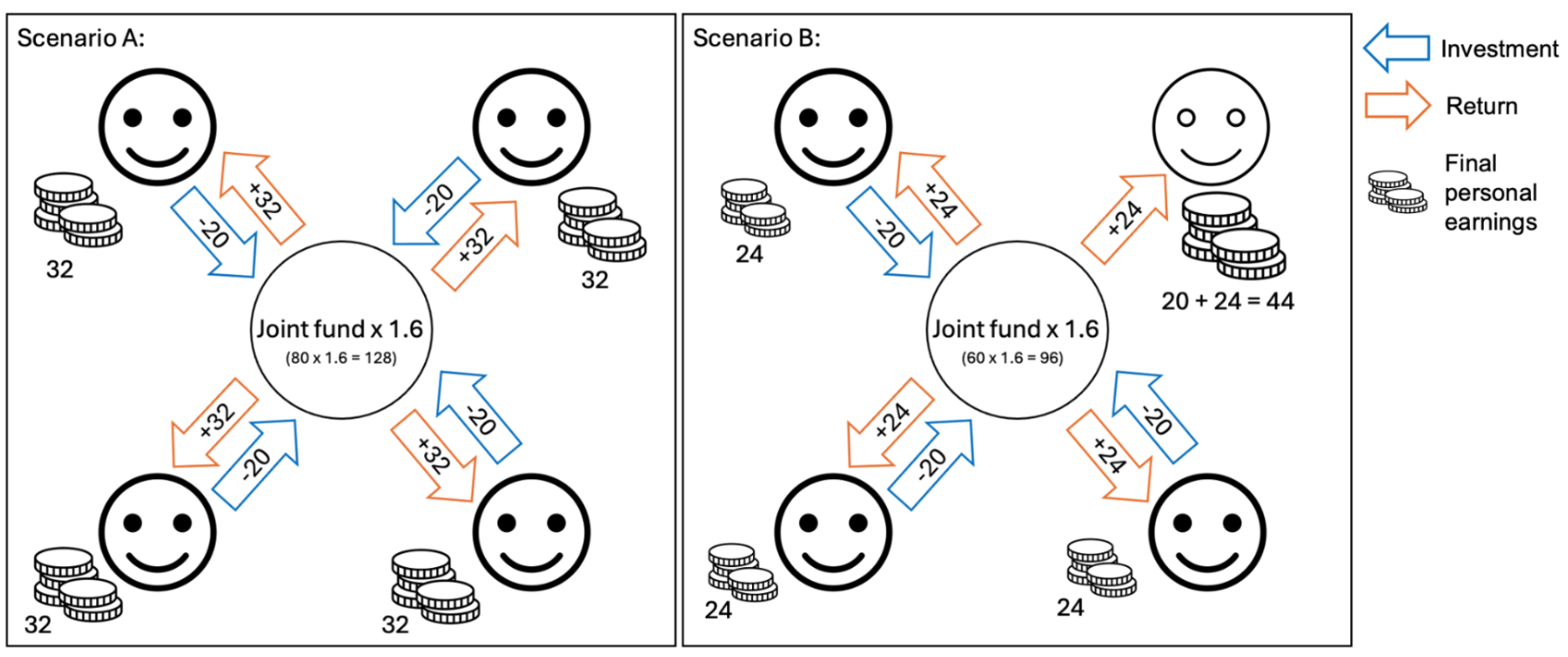
A total of 240 students participated in six rounds of the game in groups of four, where the group constellation was changed after every round. The participants were asked at the beginning of each round how much they would be willing to invest of their previously assigned 20 money units in a joint fund. Every money unit contributed to this fund generated a return of 0.4 money units for each group member, regardless of their own contribution. While investing one money unit leads to a group return of 1.6 money units, individuals only received 0.4 money units return for every invested money unit. This means, if all group members invested all their 20 money units, this would result in earnings of 32 money units per person – this is the solution that has the highest benefit for the group as a whole (see Figure 1, Scenario A).
Individuals, however, could also decide to boost their personal income by not investing anything into the joint fund and reaping the benefits of others’ contributions (free riding) – this is the solution that has the highest benefit for each individual player.
If only three people would invest all their money while one person decided to invest nothing, the three contributors each would receive 24 money units, while the free rider would benefit from the joint fund even more, receiving a total of 44 money units! This payoff would consist of the retained 20 money units plus 24 money units received from the shared fund (see Figure 1, Scenario B). This scenario highlights that there is a clear incentive to free ride. By withholding contributions while still benefiting from the joint fund of others, an individual can maximize their personal reward but reduce the returns of the contributing group members.
The catch of this experiment was that participants were randomly assigned to two groups: in group 1, participants stayed anonymous after each round – with the consequence that free riding became increasingly popular: at the end of the sixth round, almost nobody contributed anymore to the group fund. However, in group 2, it was possible to punish group members who contributed little or nothing to the joint fund: in this condition, participants were asked after every round if they would like to punish one of the other members based on their investment. Punishing a member of the group would lead to the punished member losing 3 money units, but at the personal cost of the punisher of one money unit. Despite this personal cost of the punisher, 84.3% of participants punished free riders at least once and 34.3% of participants punished free riders more than five times. Importantly, this punishment led to an increase of cooperation over the course of the rounds of the experiment, which was in sharp contrast to the condition where punishment was not possible.
These results provide evidence for altruistic punishment by demonstrating that individuals are willing to punish free riders at a personal cost, even when they receive no immediate benefit from doing so. The increase of cooperation in the punishment condition showed that altruistic punishment can help to sustain and even increase cooperative behavior, whereas the absence of punishment leads to more free riding behavior and less cooperation. Importantly, the mere possibility of punishment led to more cooperation, as participants invested more in the shared fund even before any punishment was actually administered.
13.2 The Aftermath
Over the years, several studies have investigated the role of punishment in promoting cooperation. For example, Balliet et al. (2011) conducted a meta-analysis of 76 studies, comprising 187 effect sizes from research conducted in 27 different countries, to examine the effect of punishment on cooperation. In line with the findings from Fehr & Gächter (2002), this meta-analysis demonstrated that punishment has an overall positive effect on cooperation in social dilemmas: when punishment among members is possible, this reliably increases the number of money units invested in the joint funds.
Social Dilemma
A social dilemma is characterized by a conflict between individual and collective interests, in which individuals either follow the collective interest by investing into the public good they use or they are tempted to invest as little as possible or extract as much as possible of public goods (i.e., they free ride), while relying on the contribution of others to the shared resource (Balliet et al., 2011).
But could such punishment behavior really count as altruistic? That is, is the punisher really motivated to enforce group norms alone? This does not seem to be always the case: already the original study by Fehr & Gächter (2002) identified the emotion of anger towards the free rider to be a trigger of punishment. Moreover, anger increased as the free riders’ contribution decreased, suggesting that perceived unfairness evokes stronger emotional response and, with that, a greater willingness to punish. In line with this finding, Rodrigues et al. (2018) showed that, in a variation of the original experiment, individuals with higher levels of trait anger tended to indeed punish free riders. But individuals with higher levels of trait altruism were more likely to compensate victims of free riders rather than punish free riders directly. Moreover, in social-dilemmas situations, where individuals interact with the same people multiple times, a degree of personal gain from punishment as a motive cannot be entirely excluded: Research by Gordon & Lea (2016) suggests that some individuals may personally benefit from punishment, as their status may increase within the group. However, this may only be the case for people who already have a positive reputation to begin with. Together these findings suggest that situational emotions as well as stable personality traits and some ulterior motives may influence the likelihood of altruistic punishment.
#yourturn
Can you think of possible emotions, motives or personality traits that might reduce an individual’s willingness to punish free riders, even when they perceive the behavior of the free rider as wrong?
Interestingly, the positive effect of punishment in promoting cooperation appears to vary across countries. One possible explanation of these cross-cultural differences might be the level of interpersonal trust within a society. In societies with higher interpersonal trust levels - i.e., where people indicate that their fellow human-beings can be trusted in everyday interactions - the altruistic punishment was more effective in increasing cooperation than in societies with lower levels of trust. Balliet & Van Lange (2013) argued that individuals in high trust societies are more likely to perceive altruistic punishment as acceptable reinforcement of their shared societal norms. In contrast, individuals in low trust societies might react negatively towards altruistic punishment, leading them to reduce their cooperation more and to even punish members of the society who punish for the sake of enforcing cooperation (Balliet & Van Lange, 2013). Effectiveness of altruistic punishment is therefore not only influenced by individual motivations but also by the broader social and cultural context (also see E. Ostrom, 2003).
#yourturn
Can you think of situations in which people in one country would be more likely to punish a free rider than people in another country? What cultural or social factors might explain these differences?
13.3 Conclusion
Altruistic punishment is an important explanation for how cooperation can be maintained in human interactions. Experimental research has consistently shown that individuals are willing to punish free riders despite personal costs and receiving no immediate benefits. Several studies could replicate these findings across different samples and settings, demonstrating the robustness of the phenomenon. Additional research shaped our understanding on factors that could motivate altruistic punishment and influence the effectiveness of it in different societies. It extends our understanding of cooperation between humans and provides valuable insights on how communities could promote and maintain cooperation to successfully manage shared resources.